
SuperBowl LX: A Flyover Representing America's 250th
America's 250th on full display with US Air Force and US Navy aircraft.
Jack Cook
2/24/20268 min read
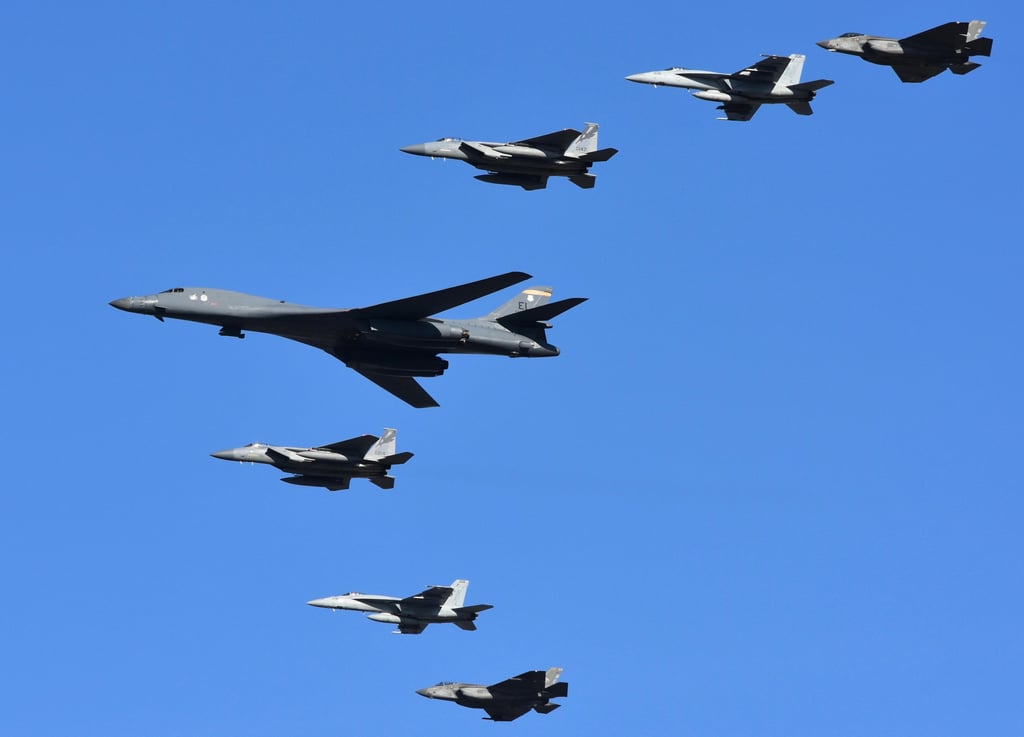
SuperBowl LX featured a Joint U.S .Air Force and Navy flyover with two US Air Force B-1B Lancer bombers, two California Air National Guard (U.S. Air Force) F-15C Eagles, and two pairs of US Navy F/A-18 Super Hornets and F-35C Lightning IIs.
The Participating Aircraft
About the Event
The Super Bowl is the major championship game in America's National Football League (NFL). It is meant to decide who ends up becoming the NFL team champion of NFL season. Since 1966, it has always been played on a Sunday. Thereby it is often called "Superbowl Sunday" amongst the general public and football fans. The 2026 SuperBowl was scheduled to be played in Santa Clara, California in the Bay Area at Levi's Stadium. The Super Bowl LX (60) game itself would be on February 8, 2026 between the New England Patriots versus the Seattle Seahawks.
Most Super Bowl games typically have some additional assets that are rather well-known by the general public. First is the halftime show, where a music act has a live performance with a whole set included. However, since 1968 another tradition for the Super Bowl is an aircraft flyover typically at the end of the national anthem. A flyover usually involves fixed-wing or sometimes rotary-wing aircraft in this case from a U.S. military branch. For the aviation enthusiasts, Super Bowl have always been a unique opportunity to witness and capture military aircraft doing a public display .
On January 21, 2026 it was announced that Super Bowl LX (60) would be a uniquely patriotic flyover. Apart from being the 60th Super Bowl, it was also coinciding with the United States 250th year of existence. The aircraft participating would be two U.S. Air Force B-1B Lancer bombers, two U.S. Air Force (California Air National Guard) F-15C Eagle fighter jets, and two pairs of U.S. Navy F/A-18 Super Hornets and F-35C Lightning IIs.
The B-1B Lancer bombers would be coming out of Ellsworth Air Force Base in South Dakota, while the remaining aircraft would be coming from bases in California. The F-15C Eagles are based at Fresno International Airport which has a joint military presence. The F/A-18 Super Hornets and F-35C Lightning IIs would be coming out Naval Air Station Lemoore in the California Central Valley.
About the Aircraft
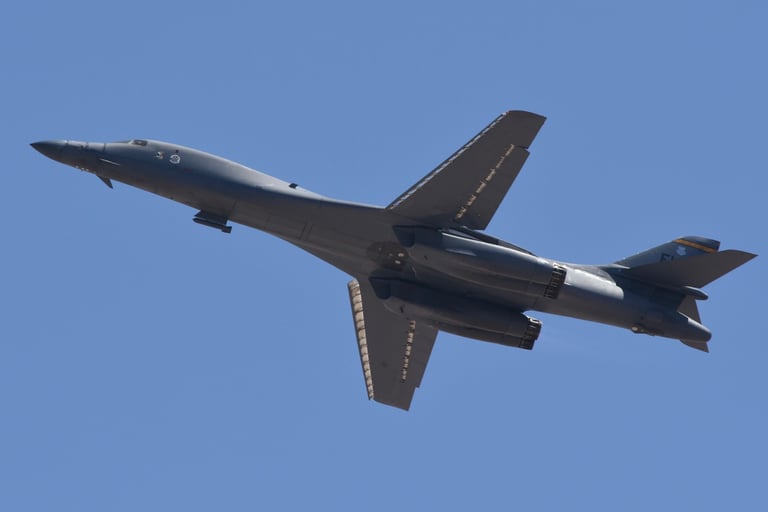
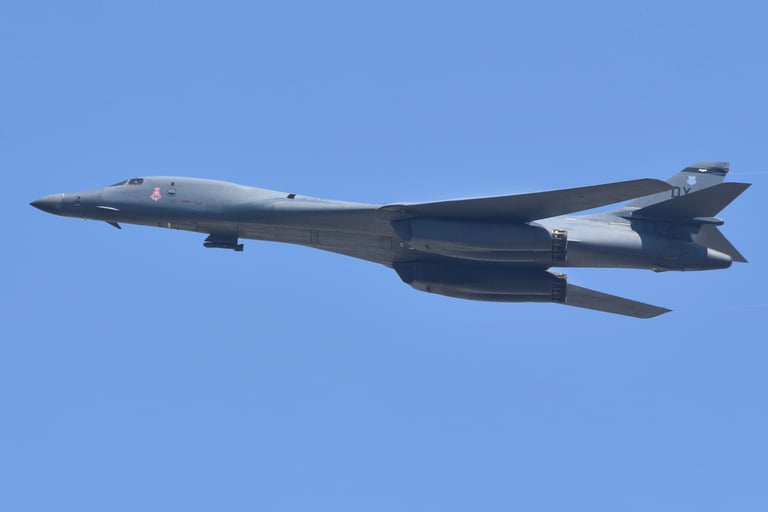
The B-1B Lancer is a high-speed variable sweep-wing bomber used by the U.S. Air Force and is capable of flying at supersonic speeds.
The B-1B Lancer or "BONE" is a supersonic variable sweep-wing bomber developed by Rockwell aircraft (now part of Boeing), powered by four General Electric after-burning engines similar to those used on fighter aircraft and capable of carrying a payload of 75,000 pounds while also flying at up 960 mph or Mach 1.2. The original B-1 variant, the B-1A which debuted in the mid 1970s was capable of flying at even faster speeds of up to Mach 2 or twice the speed of sound. However, the original B-1 was cancelled by the Carter Administration due to high development costs. Instead the Carter Administration decided to allocate funding to retrofitting older B-52 bombers with newer technology. At the same time, they also were supporting the development of the future B-2 Stealth bomber (as discussed in the New Years Day flyover post). However, due to the B-2 program cost overruns and delays, the B-1 program was brought back in the early 1980s under the newly appointed Reagan Administration. This time, it was now renamed the B-1B and designed differently, while it was now only capable of flying up to Mach 1.2 it was now designed with some stealthy features that made it less visible on enemy radar than a B-52 while also going considerably faster. The B-1B has a radar signature 100 times smaller than the older B-52 bomber. One major reason for this was the constantly updating development of soviet missile technology during the later Cold War.
Since entering service in the mid 1980s, the B-1B has served in various conflicts. While the B-1B never actually was used to attack the Soviet Union (its original purpose) it has seen combat operations in various other global conflicts. The B-1Bs first taste in combat occurred in 1998 in Iraq during Operation Desert Fox, and shortly afterwards was used rather heavily during Operation Allied Force: The 1999 NATO Bombing of Yugoslavia. Later It was used in Afghanistan, Iraq as well as recently deploying strikes on Syria and even the U.S. Operations in Venezuela. Today, there are 45 B-1Bs in use with the U.S. Air Force. The two operational B-1B Lancer bases are Ellsworth Air Force Base in South Dakota, which participated in this Super Bowl flyover and Dyess Air Force Base in Texas.
The B-1B Lancer is supposed to be retired by 2036 and replaced by the new B-21 Raider, the new stealth bomber also meant to replace the B-2 Spirit.
The F-35C Lightning II is a naval variant of the F-35 Lightning II that is also carrier-capable and has a larger wing design.
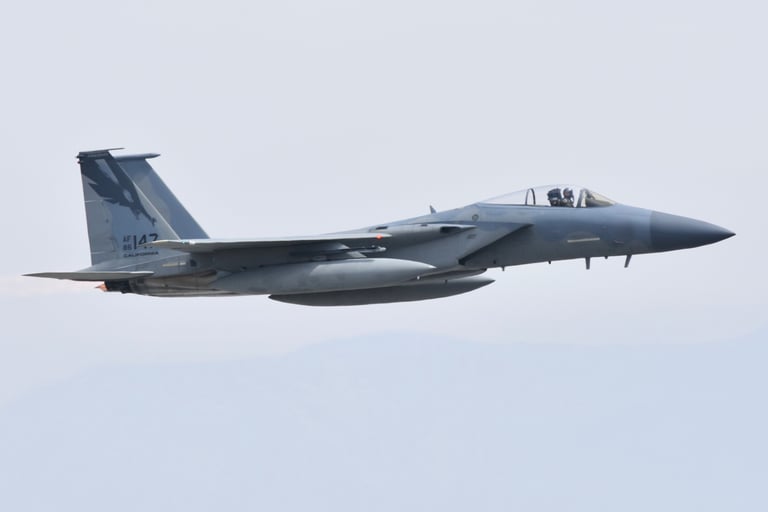
The F-15C Eagle is an all-weather Air Superiority fighter that has been in service since the 1970s and 80s and has claimed over 100 enemy aircraft.
During the late 1960s, the U.S. Air Force and the U.S. Navy was requesting a newer fighter aircraft capable of achieving air superiority and able to outclass any existing aircraft built by the Soviet Union. One such example was the MiG-25 'Foxbat', a high-speed, high-altitude interceptor developed by the Soviet Union. The Development of the MiG-25 led to the Grumman (now Northrop Grumman) F-14 Tomcat for the U.S. Navy, and the McDonnell Douglas (now part of Boeing) F-15 Eagle for the U.S. Air Force. Shortly after the F-15 entered operation, It was later determined that the MiG-25 was actually a far less capable aircraft than the F-15. After a MiG-25 defected to Japan, and both U.S. and Japanese authorities examined the aircraft and determined it a far less capable aircraft than initially assumed.
The F-15 has been operated by the U.S. Air Force since the mid 1970s, and is also used by the Israeli and Japanese Air Forces. The Israeli Air Force in particular has shot down the most of any Air Force operating the F-15. The F-15C Eagle has been used by the U.S. Air Force in Operation Desert Storm in the 1991 Iraq War, as well as during the NATO intervention in Yugoslavia in 1999 during Operation Allied Force. Today, most F-15C variants are used by Air National Guard units, including at this Super Bowl flyover. The majority of older F-15s are being replaced by newer F-15EX variants.
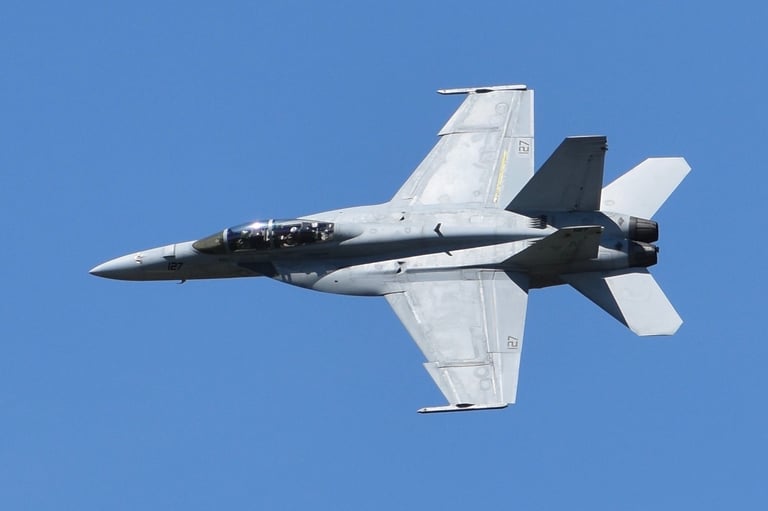
The F/A-18 Super Hornet is an all-weather carrier-capable fighter that is a larger variant of the legacy F/A-18 Hornet.
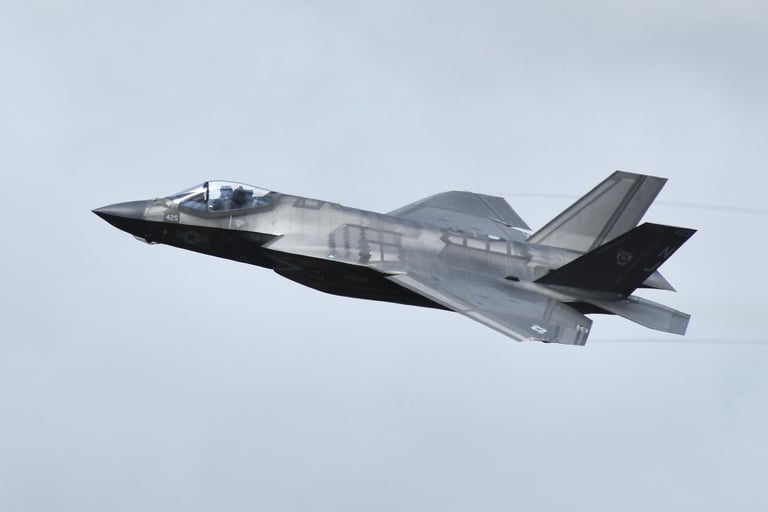
Both the U.S. Navy F/A-18 Super Hornet and F-35C Lightning are carrier-capable fighter aircraft that are specialized variants of existing aircraft designs. The F/A-18 Super Hornet multi-role, carrier-capable, fighter is a newer and larger version of the legacy F/A-18 Hornet. It was built as a replacement for the iconic F-14 Tomcat and entered service in 2001. Since entering service, the Super Hornet has also seen significant combat use in the Middle East, in particular Afghanistan and Iraq. The F/A-18 Super Hornet also was made famous as the main aircraft in the 2022 film 'Top Gun:Maverick' starring Tom Cruise.
Meanwhile, the F-35C Lightning II is the purpose-built version of the venerable F-35 Lightning II, for the U.S. Navy. The F-35 is a multi-role fighter and also includes stealth technology. The F-35C Lightning II is a carrier-capable version of the F-35 and has a larger wing than other F-35 variants which gives it the capability of lower landing speeds and better range. Both aircraft participating in the Super Bowl flyover were out of NAS Lemoore in the Central Valley in California.
The Flyover
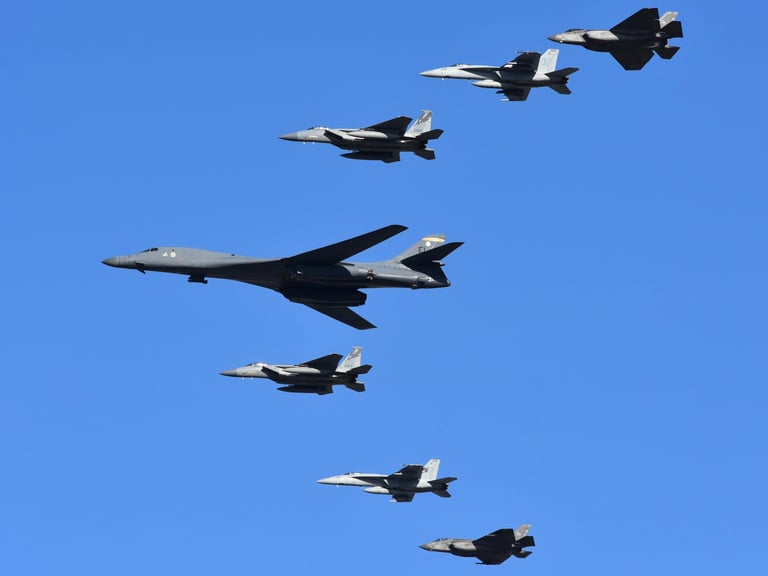
A few days prior to the Super Bowl, on February 6 the Air Force and the Navy conducted a practice flyover above Levi Stadium. The flyover included a Delta formation with the B-1B Lancer in the lead, and both pair of fighters flanking it on either side. The second B-1B came up from behind with the four afterburner engines lit up and its wings swept back for high-speed flight. Although this was a practice run, it was most likely going to be exactly the same flyover come game day.
On the day of the announcement of the participating aircraft, the weather initially was calling for cloudy and possibly rainy skies. However, as game day approached the weather forecast continued improving and was now gonna be mostly clear skies. With the weather clear, and the formation known it was showtime.
A few hours before game kickoff, the B-1B Lancers callsign DRAGO11 Departed Ellsworth Air Force Base in South Dakota heading west. Once they reached California, the F-15C Eagles Departed from Fresno as DRAGO21 with the Navy F/A-18 Super Hornets and F-35s using the nearby Moffett Field following suit with the callsign DRAGO31 and DRAGO41. Once airborne, the eight aircraft joined up in a holding pattern south of San Jose and Levi Stadium. Although there were eight aircraft intended for the flyover, some witnesses later recalled seeing a third B-1B near the formation as they were in the holding pattern. The third B-1B was intended as a backup in case one of the B-1s had an issue. While the B-1B is a rather versatile and flexible platform, it is often experiencing mechanical issues more frequently than other bombers. So it made sense an additional aircraft was on standby for the flyover.
Then, shortly before 3:30pm, the formation exited the holding pattern and had descended to a lower altitude and began flying north in the direction of Levi Stadium. At that very moment, famed musician Charlie Puth, known for his collab single "See You Again" began performing the National Anthem at the Stadium. With U.S. military precision at its finest, the formation appeared directly over Levi Stadium at the moment Charlie Puth finished the National Anthem. Just behind the main formation, possibly to the surprise of many in the stadium, the second B-1B Lancer came zooming overhead with all four engines at full-power and creating a tremendous earth-shaking noise in its wake.
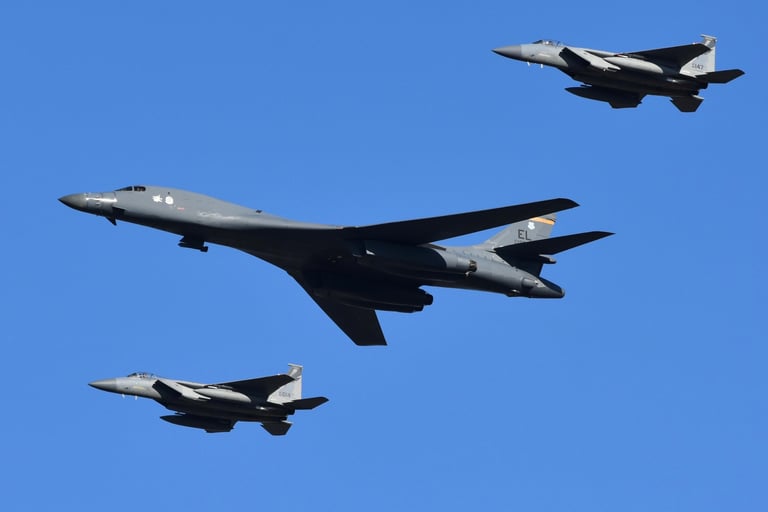
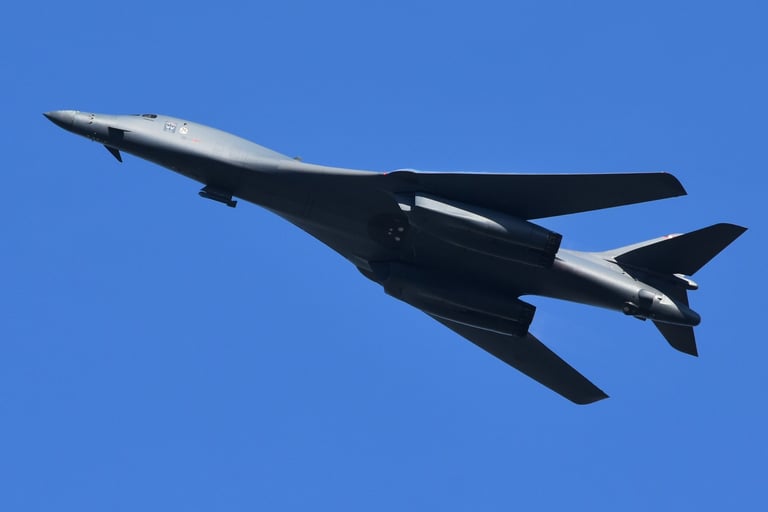
DRAGO11 (B-1B Lancer) leading the formation with DRAGO21 (two F-15C Eagles) on each of its wing.
The Full DRAGO formation with DRAGO31 (F/A-18 Super Hornets) and DRAGO41 (F-35C Lightning IIs) as they flew over the Stadium.
The lone B-1B Lancer behind the formation conducting the high-speed flyover with the afterburners lit and wings swept back.
While some people may have watched the flyover live or in person, there is no question it was one that will be discussed for years if not decades to come. Considering the United States' 250th birthday, this years Super Bowl flyover was perhaps the most memorable if not the best in aviation and sports history. Perhaps due to the joint U.S. Air Force and U.S. Navy participation, or the number of aircraft involved. It may even just be the whole reason for the flyover being so bombastic this year: America's 250th. Nevertheless, Super Bowl LX was a memorable one not just for the football lovers, or Bad Bunny fans given his halftime show, but also for its massive aviation display as part of the flyover.
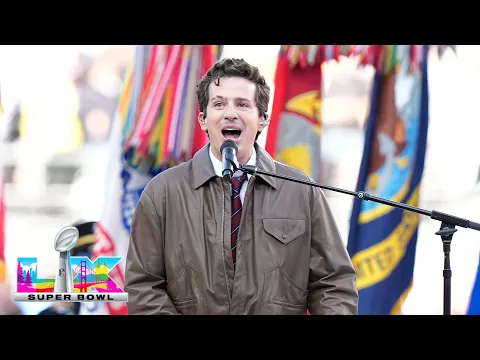
The final shot of the two B-1B pilots giving a fist-bump is included in the video above. That crew was flying the second B-1B at high-speed in afterburner.